Plant Sales Live on JuliaRedman.com
 I recently attended the ASM conference in San Diego, CA. It was a good conference, I attended several interesting lectures both related and unrelated to my own research, and also enjoyed just being in San Diego in the few off hours I had. My traveling companion and I stayed at the Hilton in the Gaslamp Quarter, which had the lovely advantage of being directly across the street from the center point of the massive conference center, making for easy access. The hotel was, sadly, otherwise rather ordinary and middle-of-the-line at best. If you go, swanky places to stay in the area seem to be the Marriott on the North end of the conference center, the Hard Rock hotel (which you can see in the photo), and the Embassy Suites.
Incidentally, we could see the terrace of the Hard Rock hotel from our room in the Hilton, and on Sunday night they had a raucous party up there, complete with loud music, not very talented go-go girls, and grid of these large queen sized beds for people to chill out on. Might have been some fire pit action as well. It really looked like fun. Then, while milling around town that afternoon looking for Gluten Free food, we heard that the Gaslamp Quarter used to be a red light district. Don't know if its true, but I fond it amusing, so now I refer to the Hard Rock terrace as "the den of iniquity". (Note to folks of the Hard Rock - I mean that in the nicest/most fun way. :P )
Anyhow, I have lots of photos to share with you, most of them plants. This is a mall we stumbled across on First Street, I think it was. It had an odd feel, multilevel with haphazard construction sort of jammed between two other buildings. I thought I was walking around in an Escher print. Very fun!
 This is, obviously, the Dole cargo ship. It was hanging out in the bay behind the conference center. I wanted to grab a bottle of rum and storm the boat for pineapples, but nobody else seemed interested.
 As far as plants go, about the strangest thing I saw were these three very large Platycerium ferns (sorry kids, not sure which, possibly superbum?) hanging on the side of a building. I was totally weirded out by this, since it seems like (a) too bright a spot, (b) too dry a climate, but there they were. There were also a couple smaller ones just by the door.
 On the front side of the conference center, near the atrium (or whatever they called that giant, permanent tent-like room), the stairs were decorated with an array of what I think were very nicely grown Aloe ferox.
 Some random succulents from the same area. Incidentally, they had whitefly.
 Strelitzias were a common sight in the area, along with cycads and palms. This is a very nicely grown Strelitzia nicolai that was on the back (West) terrace of the conference center. I basked in the sun for about an hour one day back there, while watching the birds repeatedly land on the flowers. I assume they were after the copious amount of sap that always seems to be all over strelitzia flowers.
 I don't know what this is, but they were lovely. I assume based on the flowers and plant form that they're in the Amaryllis family. Please leave a comment if you know what it is. Note: They were purpleish, not blue, my camera doesn't seem to understand that particular shade. I fixed the color balance as much as I could, but it might still be a little off.
NOTE: This has been identified as Agapanthus africanus by Beverly. Thanks Bev! As above, I don't know what this tree is, but they seemed popular in the area. Please leave a comment if you can identify it.
I'd like to go back sometime and experience more of the area. The weather was phenomenal, 65 and sunny every day (glad I checked the forecasts before leaving, that's a good 20 degrees F less than MD!!), and it just seemed like a quiet, easy going area. Incidentally, Sammy's Woodfired Pizza, located on Fourth Avenue in the Gaslamp Quarter, has the BEST GLUTEN FREE PIZZA EVER!!! Sammy, when are you opening a shop in the state of Maryland!? I miss you already.
 Some of you may recall my approach to lettuce. It just so happens, I take a similar hippie approach to radishes. I don't always plant them, but I always have them owing to the fact that I usually let a few bloom and drop their seeds everywhere. This year I was delighted to find that I finally have some hybrid radishes. The crop is long, like a white radish, but have a slightly milder flavor and some color on them like the little red radishes. I like this because (a) they're bigger than the teeny red radishes, and (b) the horseradish-like flavor of those white radishes is a bit much for me. Not that I don't like spicy, just not that type. Another reason I let my radishes go to seed is they young seed pods are a right tasty snack as a fresh munchie of salad topping. But here again, the white radishes produce a very strong seed pod, that while lovely pickled, is not to my taste fresh. Hopefully these hybrids will find a nice balance somewhere in-between.Flowers are a standard brassica-type shape and color (yellow), held on a big, bushy inflorescence. To store seed, let the pods mature and dry, and select branches with no evidence of mould. Then crush open the dry pods and sift out the seed. To let them do their 'thing' in the garden, just knock the seed pods off the dry stems or let them fall on their own. The seeds may or may not actually come out of the pods, but they often still manage to germinate through them. I never put any effort into that part, that's why its called "Lazy Gardening."
 Today's selections are all miniature plants, defined as less than 6" tall, though many are well below that. Among miniature orchid species you will find a microcosm of delight, though you may require a magnifying glass to truly appreciate some.
This first selection, labeled Gehis. japonicus, has sprays of wee flowers of no more than 5mm in height. I take the label to indicate Gastrochilus japonicus, and the flowers do look similar to gastrochilus, but the foliage is all wrong and the flowers and plant are too small even for the species Gastrochilus japonicus. Perhaps I have misunderstood the abbreviation Gehis?
***UPDATE: Orchid Eric wrote to tell me that this plant is actually Omoea philippinensis. Thanks for the identification, Eric!*** Next we have a nearly microscopic Dendrobium, Den. toressae. Again with this, flowers (and also leaves!) are up to a whopping 5mm. I have to assume based on the plant habit and flower type and bearing that it is related to Den. lichenastrum. It may even have some odor associated with it, if you care to risk inhaling the entire flower.
 This Masdevallia ferrusii was nestled into Andy's Orchids wardian case display, along with today's last selection Pleurothallis asaroides 'Walter'. Both of these had flowers in the 3/4 to 1 inch range, and as you can see, both with unusual forms. I really can't tell you much else about either species. Masdevallias are typically from new world Alpine cloud forest areas, meaning cool, damp, and buoyant air. Pleuros have a range of environments, especially in temperature, so it pays to do your research and ask questions when buying one of these guys.
 Today I'd like to share two recent acquisitions, purchased from Andy's Orchids at the SEPOS show. First is Den. pugioniforme, a species with a curious chain like habit, and fragrant, apple-green flowers. According to the Andy's folks, the chains of leaves, which seem to grow in the fashion "stem, leaf, branch from leaf axil -> new stem, leaf...", can reach several feet in length.
 Dendrobium lichenastrum v. prenticei, sometimes just Den. prenticei, is another of those nifty succulent-type species. This one has 1-2 inch long, fleshy leaves. Flowers are typically cream to yellow, though once I had a very nice one that was white with pink stripes. Their fragrance falls into the category I like to refer to as 'little dead things', as they typically smell like fish, but it isn't terribly strong, so its Ok. Even with, its a very cute little species, best grown mounted with phals or a bit brighter.

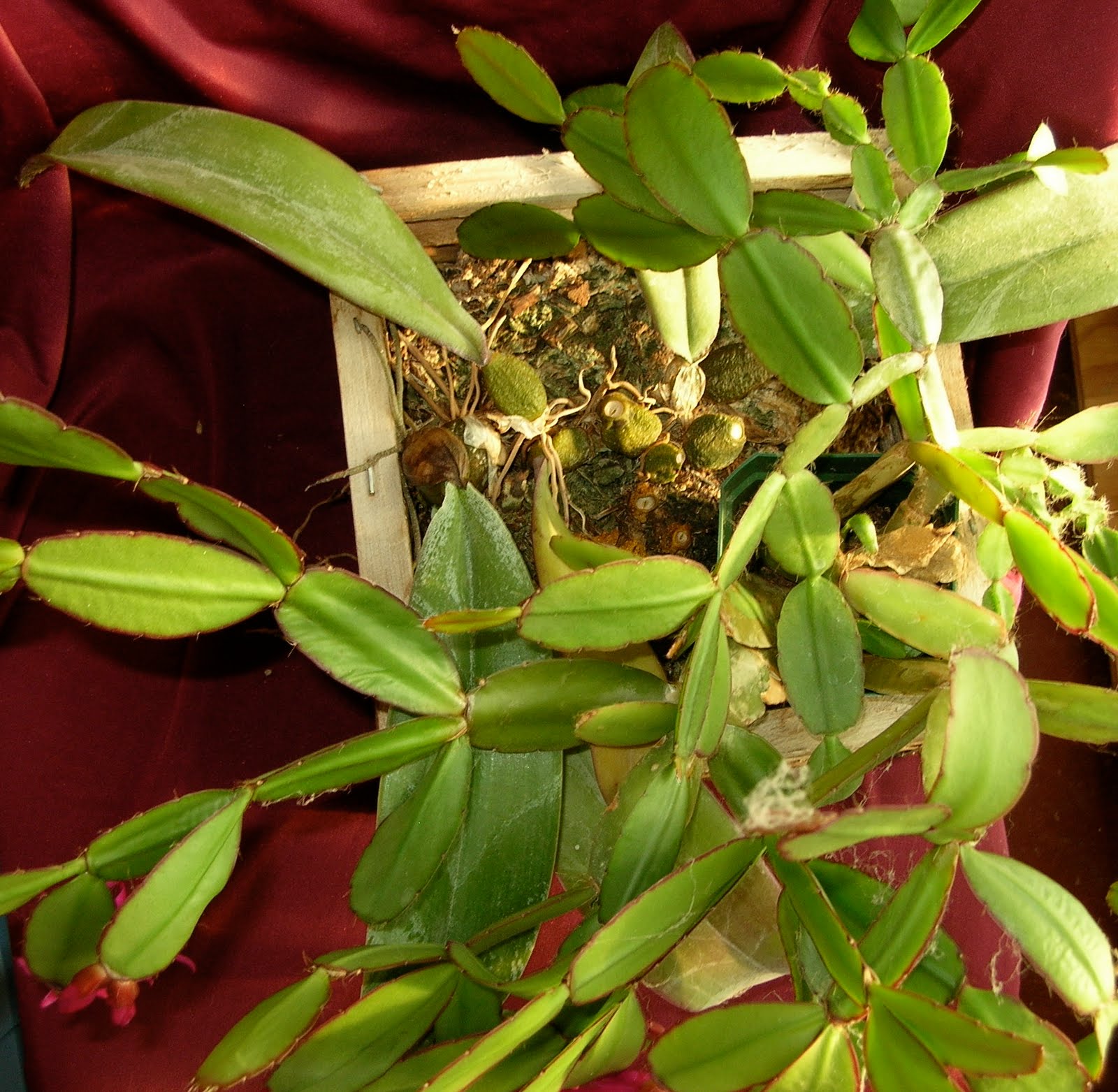
 Today we have something a little different - a jungle cactus. A few years ago I talked a cutting out of a friend of mine. I rather liked this one because of that really neat purple-pink outline on all the segments. They are easy to root, you just break off a an oval segment or two, let the broken end dry a couple days, then pot it in damp media such that the lower third of the segment is in the media. I have used both sphagnum moss and regular potting soil for this. Eventually it will just root.Succulents of this type are typically referred to as Christmas or Easter cacti, as they tend to bloom at those times of year. Blooming is induced by a short day. This is an important point. If you are keeping them under artificial light for 12 hrs a day, they will NOT bloom. This guy lives in an East facing window on a lower shelf, so is 'shaded' from any overhead lighting. My mother used to induce blooming in her Christmas cactus by moving it to the North-facing basement window for several weeks during winter to induce blooming. Other than these points, I pretty much grow it like a Phalaenopsis.The problem I'm having with this plant is that I stupidly set it on top of a basket containing a Bulbophyllum phalaenopsis seedling, and it promptly rooted into the media. I have two choices: Leave it, which will most likely result in it slowly overtaking the entirety of the basket, or wait until flowering is over and rip its pot off the surface of the basket. I will most likely do the second, and it will recover. The probability of damage long-term to that Bubophyllum is too high, and replacing a seedling of that age is not an option. They're too hard to find. But in the mean time, the cactus is pretty to look at!

 Today I'll show you a few of the Dendrobium selections at SEPOS this year. First off, we have two color varieties of a very cute, compact species: Den. kingianum 'Karl Marx' and Den. kingianum 'Big Foot' AM/AOS. Den. kingianum is typically fragrant and the plant compact in stature, but with spikes height is up to about 15 or 18 inches perhaps, and they can form large clumps. A large clump is of course rather impressive when in bloom. These two guys were exceptionally lovely. As much as this is often considered a 'common' species, not many people seem to grow it around here. Perhaps the appearance of these two at the show professes a coming increase in popularity.
 Next, a most interesting small species, Den. lingueforme displayed by Andy's Orchids. By the flowers I wouldn't be surprised if this one has been moved between genus' a few times. It was displayed in one of his trademark Wardian cases, stuffed to the gills with interesting little bits. Leaves on this guy are about an inch long, succulent and multicolored with the tactile characteristic of very fine grit sandpaper. He had a couple for sale. I snatched one up - couldn't resist such a weird looking thing.
 We'll finish out today with a Den. johannis. This is a rather tall plant topped by a spray of twisty, earthy flowers.
 I just love spring. So many things in bloom and glorious, warm and sunny weather make a fantastic combination. This seedling of Phal (braceana x venosa), one of Al's crosses, started opening flowers a few weeks ago and now has several on it. They're cute, round, glossy and deeply colored, held on a spunky stem from a very compact, dark-leafed plant. However they've inherited the venosa fragrance, rather than braceana's fruity-sweet scent. For those of you who don't know, Phal. venosa doesn't have a very appealing scent, but it isn't altogether offensive either. Suspicious, might be a better descriptor. I often describe it as 'not very good bacon.' This seedling, I've decided, smells exactly like beef jerky. Its about the right color as well. Regardless, I think its fantastic and have already distributed its pollen around the house. I hope something takes and gives us something fun!