
Hey folks, just a quick note to tell you I'm still alive and let you know there's a new photo of Dockrillia bowmanii on the Internet Orchid Species Photo Encyclopedia! Check it out here. You may remember this photo - it is one of mine. You can see more photos of the species on this older post.
I did at that time of that post introduce bowmanii and rigidum to each other, but they didn't really get along. There are no awesome seedlings to report. Not surprising. They're pretty different in terms of growth habit, and those weird Dendrobium alliance things can be picky about their dates. Pity.
Remember, if you have orchid culture questions, please feel free to ask. I enjoy chatting about plants, but also questions are usually the inspiration for some of my best articles, and I could really use a jump start! My blogging battery seems a bit dead here. Sorry about that, working on it...
Monday, July 25, 2011

Sunday, March 13, 2011
2011 MOS Show
The Maryland Orchid Society annual show was held this weekend at the state fairgrounds in Timonium, MD. I went for a look on Friday evening and brought back the following images for you. This year the show seemed smaller than in previous years, and at the risk of being critical, there were a surprising number of flowers in less than optimal shape. I rather think folks should only send their best. That said, there were still several gems to be seen at the show.
First, lets look at some exceptional Cattleya hybrids:
 Rlc. Lebenkreis, exhibited by Fishing Creek, was awarded an AM of 80 points at the show. It had wonderful color, velvety texture, and pleasing shape. The plant is bred out of Slc. Circle of Life and at first, that is what I thought I was looking at. A very lovely little thing.
 A very nicely grown Slc. (a.k.a. Cattlianthe) Hazel Boyd 'Apricot Glow' HCC/AOS. This cross is of special note for its extensive use in hybridizing. Hazel Boyd was registered in 1975, and since, 154 hybrids have been registered which used Hazel Boyd as a parent. I don't know offhand how many grandchildren it has, but I'm sure there are many.

Incidentally, Slc. Jewel Box was a parent of Slc. Hazel Boyd. This clone is 'Dark Waters' AM/AOS, and is very well grown and bloomed out.
 For this group, we'll end with Slc. Memoria Alvin Beggman 'Poem', which I thought was devastatingly cute. In fact, if you know who might be offering these wholesale, please let me know. The plant was very compact, and the color was clear and bright.
From here, we'll move on to Cattleya species, which have become a fascination of mine of late.
 First up is Cattleya intermedia var. orlata 'Crown Fox' HCC/AOS. The plant was wonderfully bloomed with more buds emerging. A wonderful show of a nice variety with excellent color. I have some C. intermedia v. orlata seedlings in the shop.
 C. lueddemanniana 'Lovelei' is another nice, but likely overlooked species. It has the look of a generic "big purple cattleya," but still has some nice markings that set it apart. Look at the venation/striping in the throat - very striking.
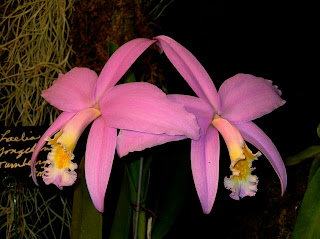 Laelia jongheana 'Turnberry' AM/AOS is a species I see occasionally at shows, and possibly I'm even seeing the same plant or couple of plants making the rounds to the spring shows. It doesn't seem to be a commonly grown species, nor commonly for sale as far as I've noticed, but it does produce very nice, flat, pastel but color saturated flowers, making a very pleasing image.
 Last in this group is a very tiny Laelia bradei, with several sunshine yellow flowers on a tiny little plant. The plant was perched up on the top edge of the display, almost out of my photographic reach. This is one of those rupicolous Laelias, typically found as a low-growing, fleshy plant on rocky areas.
Following the L. bradei, we'll look at a couple other miniature species found at the show.
 Cadetia taylori is a species I've always thought was adorable. This is a tallish one at perhaps 4" tall, and grown into a neat porcupine on its little stick mount. Flowers are typically about half a cm with fragrance like anise, though I've always thought if I sniffed to hard I'd snort them right up my nose.
 Leptotes tenuis, approximately a 2-3 inch tall plant.
 And no miniature selection would be complete without a cute little Bulbophyllum species. This one was labeled pleuro-thallianthum, which I've never heard of and isn't listed in the ISOPE database, but that isn't hard to do with Bulbophyllums. There are so many. Its flowers remind me of a species I once had called macroleum, but I think the growth morphology was slightly different.
In closing, I'll leave you with my favorite Paphiopedilum of the day:
 This Paph. haynaldianum x philippinense had beautiful markings with striking contrast and clear, deep color. I suspect it wasn't finished opening, though, and as it matures, the petals will probably twist and may elongate. The only thing that would make it more awesome would be a dark pouch. But even still, I'd really like to have that.
First, lets look at some exceptional Cattleya hybrids:
 Rlc. Lebenkreis, exhibited by Fishing Creek, was awarded an AM of 80 points at the show. It had wonderful color, velvety texture, and pleasing shape. The plant is bred out of Slc. Circle of Life and at first, that is what I thought I was looking at. A very lovely little thing.
 A very nicely grown Slc. (a.k.a. Cattlianthe) Hazel Boyd 'Apricot Glow' HCC/AOS. This cross is of special note for its extensive use in hybridizing. Hazel Boyd was registered in 1975, and since, 154 hybrids have been registered which used Hazel Boyd as a parent. I don't know offhand how many grandchildren it has, but I'm sure there are many.
Incidentally, Slc. Jewel Box was a parent of Slc. Hazel Boyd. This clone is 'Dark Waters' AM/AOS, and is very well grown and bloomed out.
 For this group, we'll end with Slc. Memoria Alvin Beggman 'Poem', which I thought was devastatingly cute. In fact, if you know who might be offering these wholesale, please let me know. The plant was very compact, and the color was clear and bright.
From here, we'll move on to Cattleya species, which have become a fascination of mine of late.
 First up is Cattleya intermedia var. orlata 'Crown Fox' HCC/AOS. The plant was wonderfully bloomed with more buds emerging. A wonderful show of a nice variety with excellent color. I have some C. intermedia v. orlata seedlings in the shop.
 C. lueddemanniana 'Lovelei' is another nice, but likely overlooked species. It has the look of a generic "big purple cattleya," but still has some nice markings that set it apart. Look at the venation/striping in the throat - very striking.
 Laelia jongheana 'Turnberry' AM/AOS is a species I see occasionally at shows, and possibly I'm even seeing the same plant or couple of plants making the rounds to the spring shows. It doesn't seem to be a commonly grown species, nor commonly for sale as far as I've noticed, but it does produce very nice, flat, pastel but color saturated flowers, making a very pleasing image.
 Last in this group is a very tiny Laelia bradei, with several sunshine yellow flowers on a tiny little plant. The plant was perched up on the top edge of the display, almost out of my photographic reach. This is one of those rupicolous Laelias, typically found as a low-growing, fleshy plant on rocky areas.
Following the L. bradei, we'll look at a couple other miniature species found at the show.
 Cadetia taylori is a species I've always thought was adorable. This is a tallish one at perhaps 4" tall, and grown into a neat porcupine on its little stick mount. Flowers are typically about half a cm with fragrance like anise, though I've always thought if I sniffed to hard I'd snort them right up my nose.
 Leptotes tenuis, approximately a 2-3 inch tall plant.
 And no miniature selection would be complete without a cute little Bulbophyllum species. This one was labeled pleuro-thallianthum, which I've never heard of and isn't listed in the ISOPE database, but that isn't hard to do with Bulbophyllums. There are so many. Its flowers remind me of a species I once had called macroleum, but I think the growth morphology was slightly different.
In closing, I'll leave you with my favorite Paphiopedilum of the day:
 This Paph. haynaldianum x philippinense had beautiful markings with striking contrast and clear, deep color. I suspect it wasn't finished opening, though, and as it matures, the petals will probably twist and may elongate. The only thing that would make it more awesome would be a dark pouch. But even still, I'd really like to have that.
Sunday, March 6, 2011
2011 Paph Forum
Hi folks! This post is a couple weeks late, but hopefully will mark my getting back on track for more frequent plant-i-licious posts. It has been a winter of much knitting, working, and complaining bitterly about the lack of sunshine. I say, "Bring on Spring!"
This year's National Capitol OS Paph Forum was held at Behnkie's Nursery in Beltsville, MD, due to the typical meeting place at the National Arboretum being under construction. It was an interesting change, presenting some good and bad points. For one, it presented a brighter space. Better light makes looking at the plants and taking photos easier, though in some cases the light was so bright that it was difficult to get photos that weren't washed out, and the backgrounds were a bit busy in some cases. The Arboretum space is always rather dark; it can be difficult to get decent photos at all. However, the space we were in for lectures is of typical greenhouse construction. Between the wind whistling across the roof and opening and closing of vents there was a lot of background noise. But regardless, the event went off without a hitch.
For your entertainment, here are a few photos from the event.
Phrag. Mary Bess 'Holly Vhee'

Phrag. Richter x Pink Panther

Paph. richardianum

Paph. micranthum 'Thoroughbred' AM/AOS

Paph. haynaldianum 'Grace Botamy'

This year's National Capitol OS Paph Forum was held at Behnkie's Nursery in Beltsville, MD, due to the typical meeting place at the National Arboretum being under construction. It was an interesting change, presenting some good and bad points. For one, it presented a brighter space. Better light makes looking at the plants and taking photos easier, though in some cases the light was so bright that it was difficult to get photos that weren't washed out, and the backgrounds were a bit busy in some cases. The Arboretum space is always rather dark; it can be difficult to get decent photos at all. However, the space we were in for lectures is of typical greenhouse construction. Between the wind whistling across the roof and opening and closing of vents there was a lot of background noise. But regardless, the event went off without a hitch.
For your entertainment, here are a few photos from the event.
Phrag. Mary Bess 'Holly Vhee'

Phrag. Richter x Pink Panther

Paph. richardianum

Paph. micranthum 'Thoroughbred' AM/AOS

Paph. haynaldianum 'Grace Botamy'

Sunday, December 12, 2010
Hi Everyone!
 Haven't posted in a while, but I'm still lurking about. Last Friday I had a table at the University of Maryland at Baltimore craft show, where I got to meet lots of plant and knitting- interested folks. I enjoyed talking to you all. I'd like to remind you all that I'm happy to help, so don't be afraid to send me your questions. :)
I also got to test out my awesome new banner. Check it out there, all glossy and whatnot. Isn't it cool?
Friday, November 26, 2010
Pest control: Meet "George"
 Meet "George", my new pest control manager. George: Keeping our Cattleyas safe from stink bugs since... yesterday.
 Notice the discarded leg on the petal below. George does a good job, but he's a bit sloppy at the table.
Saturday, November 20, 2010
In Bloom: A Study of Dendrobium bowmanii


 These are Dendrobium bowmanii, synonym mortii, synonym Dockrillia bowmanii. I have five of these and four are currently in bloom. As you can see in the photos, they grow on long, spindly stems with needle-like leaves perhaps 3 inches long and very narrow, flowering from the nodes at the base of the fleshy leaves like other Dockrillas. Notice also the flowers are held up-side-down, another Dockrilla trait. The flowers are vaguely fragrant with a minty odor, matching nicely with their yellow-green color, and last about 2-3 weeks.
According to IOSPE, the species is native to mangrove swamps in Australia, and prefers warm to hot temperatures year round with a slightly drier winter rest.
I also have a Dendrobium rigidum blooming right now. I think I'll go off and introduce them to each other to see if we can't get something interesting...
Tuesday, November 9, 2010
In Bloom: Random Orange Stuff
It's Autumn, and we here on the East coast have been enjoying the fall foliage. It is ephemeral, fleeting, beautiful but ever-changing and far too temporary. But believe it or not, with the waning of Autumn color marks an increase in the number of blooming activity at our house, especially orchids, but I've got some other things as well. In honor of Autumn color, here are a few orange selections.
 Sophronitis cernua blooming out of season. Supposedly they are Spring bloomers, but this is not the first time I've seen one have other ideas. This species is native to Southeastern Brazil, in warmer and brighter locations than you would typically find the other Sophronitis species. Hence, this one may grow for people that have had trouble with its cool and shady -growing relatives.
 This is Clivia x Crytanthiflora, a naturally-occurring hybrid between two species miniata and nobilis. I've shown you this plant before, but I rather like her so you get to see her again. I did a major repotting of most of my clivias (it was kind of like, "when did I get SO MANY!?") this summer, and attempted to repot this one. Note: "Attempted." I couldn't get it out of the pot. When happy, Clivias have a rather aggressive root system consisting of thick, succulent, tentacle-like structures, a style which is consistent with certain other plants of South African origin, such as Strelitzias, and bearing some similarity to the structure of certain beefy orchid roots. I had two options with this plant: Break it out of the pot or leave it be. I wasn't in the frame of mind to crack open a very thick clay pot, and if the root system was that dense I wasn't sure I had an appropriately sized pot for it to go into, so I took option B.

 I love aloes, especially the little ones with cool leaves, but this is perhaps my favorite. This is Aloe bellatula. That is a 3 inch clay pot. I divided this plant this spring, selling one division, and keeping this one and one other. I had fully intended to sell another division, but they're just SO CUTE. Give me time, I'll either produce more divisions or will finally reconcile giving up my extra. Its like meeting a litter of kittens...I just want to keep them all. Anyway, its easy to grow and a reliable bloomer, though not as prolific a bloomer as some of the little Aloes, it does bloom at least once every year with these adorable bell-shaped orange-peach flowers. I'm not terribly knowledgeable on succulents, but I'll tell you what works for me. I keep the plant with my intermediate-growing cattleyas, meaning it lives in my unheated basement during the Winter and gets watered a lot less than during the Summer, but does still get watered a least a little bit every 2-3 weeks. In summer it gets watered every 2-3 days, especially when it is very hot and sunny.
 Sophronitis cernua blooming out of season. Supposedly they are Spring bloomers, but this is not the first time I've seen one have other ideas. This species is native to Southeastern Brazil, in warmer and brighter locations than you would typically find the other Sophronitis species. Hence, this one may grow for people that have had trouble with its cool and shady -growing relatives.
 This is Clivia x Crytanthiflora, a naturally-occurring hybrid between two species miniata and nobilis. I've shown you this plant before, but I rather like her so you get to see her again. I did a major repotting of most of my clivias (it was kind of like, "when did I get SO MANY!?") this summer, and attempted to repot this one. Note: "Attempted." I couldn't get it out of the pot. When happy, Clivias have a rather aggressive root system consisting of thick, succulent, tentacle-like structures, a style which is consistent with certain other plants of South African origin, such as Strelitzias, and bearing some similarity to the structure of certain beefy orchid roots. I had two options with this plant: Break it out of the pot or leave it be. I wasn't in the frame of mind to crack open a very thick clay pot, and if the root system was that dense I wasn't sure I had an appropriately sized pot for it to go into, so I took option B.
 I love aloes, especially the little ones with cool leaves, but this is perhaps my favorite. This is Aloe bellatula. That is a 3 inch clay pot. I divided this plant this spring, selling one division, and keeping this one and one other. I had fully intended to sell another division, but they're just SO CUTE. Give me time, I'll either produce more divisions or will finally reconcile giving up my extra. Its like meeting a litter of kittens...I just want to keep them all. Anyway, its easy to grow and a reliable bloomer, though not as prolific a bloomer as some of the little Aloes, it does bloom at least once every year with these adorable bell-shaped orange-peach flowers. I'm not terribly knowledgeable on succulents, but I'll tell you what works for me. I keep the plant with my intermediate-growing cattleyas, meaning it lives in my unheated basement during the Winter and gets watered a lot less than during the Summer, but does still get watered a least a little bit every 2-3 weeks. In summer it gets watered every 2-3 days, especially when it is very hot and sunny.
Subscribe to:
Posts (Atom)