Plant Sales Live on JuliaRedman.com
 This is Rosalind, born here at the farm New Year's Eve 2009. In addition to the photo at left, we have extensive evidence of her cuteness. But *do not be fooled!*
I was away a couple days, and I came home to mass destruction. Example below. There was much munching on several cattleya plants, some blooming size, some compots, like this one. This pot was the worst of the compots, and one of the in-bud plants was reduced to a few growths from about 8. Needless to say, I was angry. Hairy monster.
Note to self: Do not keep rabbits and orchids on same floor of house.
I suppose in retrospect I should have suspected she was not the angelic fuzz-producer she passed herself off as. I did, after all, witness this chummy water-cooler discussion between her and the local daemons.


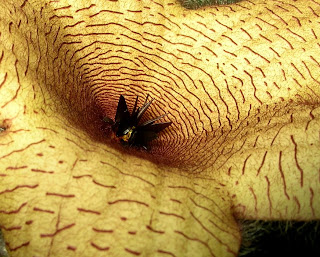
 What is it??? Dead things, hairy things, fake dead things with fake worms? Ew. It sure smells like dead things.
This is Stapelia gigantea, with flowers easily 10 inches across and up to 12 inches across. The buds take weeks to develop. By the time they're the size of a small lemon you think, "It's sure to open soon!" But alas, it will still have several weeks to go. They pop (litterally) open when they get to about the size of an average orange. Then they proceed to stink and attract flies.
Most people will grow these in well drained soil, but ever the oddball, my approach is to grow it in sphagnum moss, allowing it to dry out completely between watering. Obviously, you can't keep it in constantly wet sphagnum, but regular wet/dry cycles works out just fine. They'll want bright light to full sun, such as the conditions in which you might grow Cattleyas. This beastie was grown from a cutting rooted about a year ago, and during that time it has doubled in size (and weight! heavy plant). They're easy to grow and very interesting to look at. Certainly a plant worth having, just don't put it on the dining room table when you have guests.
 Hi folks! I'm still alive in my little cave. Been busy around here, but life with the plants keeps trudging on as well.Today I thought I'd share two sort-of blue things in bloom. The first is Lc. Cariads Mini-Quinee (C. intermedia x Lc. Mini Purple). I bought a small group of these seedlings a little while back because I rather like Mini Purple, though my favorite clone is 'Tamami', which isn't blue. This was most likely bred from one of the many coerulea clones. For those of you checking your monitor color, no, it isn't blue as in cobalt, blueberry, or anything else of that nature. Blue in orchids is this funny purple way off into the cool color spectrum. I'm rather pleased with this plant. It is nice and compact, like you would expect from that parentage. Higher flower count would be nice, but Mini Purple being L. pumilia x C. walkeriana, you can't expect it to be too high. It is also a first bloom, so maybe on the next we'll get two or three flowers. It is very lightly fragrant.While taking pictures of it, I realized it has about the same colors as my current weaving project. I'm going to pretend that was on purpose. :)
 Our second plant only does the vague impression of blue, and is actually pink. It is Phal. Equalacea 'Leesburg Sky' x violacea v. coerulea 'Nancy's Gift'. It could have been blue, but it isn't. I've decided I don't care. This one opened kinda funny, but in general they're cute, novelty type flowers with sweet fragrance, and it intermittently throws flowers throughout the summer. I tried to breed it earlier this Summer but it didn't take. In general it hasn't been a good summer for breeding orchids for me - lots of failures which I'm rather cranky about. So instead I have some flasks on the way from Florida. Nothing beats instant gratification.
 In other news, I've got ten overgrown compots of cattleya seedlings to plant out. Heaven help me. That's a lot of untangling...
 A study published in Feb 2008 cites keeping plants at your desk may result in more satisfaction with your job. Based on surveys, the study finds that employees with live plants or windows in their offices had more positive and mellow responses to a range of questions vs. those who lived in a basic cube. Basically, they tended to feel more like people with good jobs rather than rats in a maze with bad food.
This makes me wonder if the move Office Space would have gone differently if the plant on Milton's desk wasn't dead. (check out this clip on YouTube, upper right hand corner)
Moral of the day: fix up your desk with a snazzy new plant and have a better day!
Read more about it:
The original journal article:
Dravigne, Andrea, Waliczek, Tina Marie, Lineberger, R.D., Zajicek, J.M. The Effect of Live Plants and Window Views of Green Spaces on Employee Perceptions of Job Satisfaction HortScience 2008 43: 183-187 [link]
Science Daily Report
LA Times Article
Just wanted to share a couple useful pocket guides.
The first one is the Organic Essentials guide to help you with your grocery shopping by showing which foods pose the greatest risk of high pesticide concentrations. Some plants absorb various toxins differently, and may hold more in the tissues than others. Other plants may not absorb toxins, but may be constructed such that washing away the pesticides is more difficult. Still others may require higher application of pesticide for good crop set. Regardless of the reason, this guide will help you make educated choices for your family when you can't always choose organic. (Please note, you should still wash all fruits and veggies, even organic ones.)
The next one is an indispensable guide every gardener should see. It identifies various predatory insects that will help clean out any pests that may be attacking your flowers and veggies. I heart predatory insects! :)
Longwood Gardens, Kennett Square, PA. Although I usually go to see the plants, and mainly those in and around the conservatory, occasionally I wonder the grounds at Longwood as well, and I always wonder what it would have been like to live on the estate. While specimens like this Dogwood tree in fruit are spectacular in their own right, there is much more to the place than the cultivated portions.
Here is a virtual tour of just a few of the highlights. A lovely Italian style portico off the pump house at the main fountain garden, one of a few enormous fountain systems on the property built in the early 1900's. The portico includes built in benches, were you might sit and rest from the sun, while considering the peace of the trees and birds.
 Also part of the Main Fountain Garden, these fellows are getting on in years. Currently they are not in use pending restoration, but the surrounding fountains are still in operation. This garden includes colored lights, used in flashing patterns set to music during their Festival of Fountains. According to the Longwood website, the most powerful jet in this garden reaches a height of 130 feet.
Imagine having a picnic here on the grass, complete with a bottle of Chianti and gentle violin notes on the breeze. Perhaps after you might retire to the portico to relax against the benches and discuss the day's events, or the upcoming evening. Among several architectural and foliage wonders, the conservatory includes a large ballroom, lavishly appointed with (walnut?) parquet floor, fabric paneled walls, marble trims and etched glass ceiling (above), not to mention its breathtaking views of the conservatory (below). The conservatory also houses an Aeolian Pipe Organ, with the console instrumentation in the ballroom itself and the pipes behind one wall of the ballroom. The wall has openings into the pipe chambers, hence the fabric wall coverings. It is...nothing short of spectacular. The custom-built monster consists of over 10,000 pipes and is the largest of its kind ever constructed. It is currently being restored. You can see the pipes but they do not play it. Personally, I would love nothing more than to hear it played, and can't wait for the opportunity.
 Perhaps after attending the ball, you may take a stroll through the Conservatory...
 ...And then out into the grounds. While pausing to admire the Chinese anemone (A. tomentosa), you might look up to discover you have left behind your European vacation, only to find yourself in a fairy tale.
 Rapunzel would have been proud of this tower. The Chimes Tower houses the Longwood estate's Carillon, which was also fairly recently restored. For more information on the history and construction of the organ and carillon, check this page.Perhaps, though, you may find this tower is not Rapunzel's home, but home to the mythological beings. Whatever am I on about? Well, the place seems to be infested with nymphs (see below).
 I suppose hemlock trees attract them.
 How often do you take time to look at the "weeds"? Most likely, if you were to pass a patch of Lobelia cardinalis (Cardinal Flower) (left) you would take notice. They are shockingly red, and in a colony they are exceptionally striking. There's almost no way you wouldn't notice them. But oddly, before this patch I don't think I've seen live ones before - only photos. According to the USDA Plants profile, the plant is native to wetlands across most of the US and Canada. It is only listed as under watch in a few states, so perhaps I have just not ever been at the right place at the right time. This particular stand, in partial shade in a mildly swampy, low lying area right next to the road, was quite breathtaking. They are attractive to hummingbirds, and an interesting variety of uses recorded in the Native American Ethnobotany Database.
 Nestled in with the Lobelia were a few plants of Ironweed (left). This is another very common genus throughout the USA and Canada. Some species have restricted range. Based on the Plants Profile maps, I think it is most likely Vernonia noveboracensis, but could also be gigantea. Either way, I think most folks would consider this member of the aster family a weed, but it is actually quite attractive with its royal purple color and compliment of butterflies. Once again, the species (assuming correct identification) has several medicinal uses listed.

 This is Rosalind, born here at the farm New Year's Eve 2009. In addition to the photo at left, we have extensive evidence of her cuteness. But *do not be fooled!*
 There was much munching on several cattleya plants, some blooming size, some compots, like this one. This pot was the worst of the compots, and one of the in-bud plants was reduced to a few growths from about 8. Needless to say, I was angry. Hairy monster.


